











November 23, 2026
0 comentários


Cover: steam-room architectural visualization from the Saunamo catalogue.
Step into a Finnish sauna and the heat is immediate: hot air, warm timber and stones waiting for the first ladleful of water. Add that water and the room changes. Löyly—the brief rise in humidity from water evaporating on the stones—moves across the benches, giving the bather a way to change the intensity of the heat.
A steam room works almost the other way around. The air temperature is much lower, typically around the mid-40s Celsius, but the room is continuously supplied with steam until the air is close to saturation. The surfaces become wet, condensation forms, and sweat does not evaporate from the skin as readily. The sensation is therefore enveloping rather than sharply hot.
The choice shapes much more than the sensation of a session. A sauna and a steam room need different construction, services and care. For a homeowner planning a substantial purchase, it helps to consider both the heat you enjoy and the kind of room your home can accommodate.
The experience is hotter air versus saturated air
A traditional Finnish sauna is sometimes described as a “dry sauna,” but the label is incomplete. The heater warms the air and a mass of stones, typically creating air temperatures around 70–100°C. Water on those stones produces löyly. Rather than staying permanently dry, the room moves between relatively dry heat and short, intentional pulses of higher humidity. A separate generator is not needed to create that sauna steam.
A steam room, or hammam-style steam enclosure, is designed around a different operating condition. A steam generator boils water outside or adjacent to the occupied room and sends steam through a dedicated pipe and outlet. Harvia recommends an operating temperature around 45–50°C for its steam-room systems. At that temperature, continuously added water vapor can keep the atmosphere very humid without requiring sauna-level air temperatures.
The physics explains why the two rooms feel different. In relatively dry air, sweat can evaporate from the skin, and that evaporation removes heat. As humidity rises, evaporation becomes less effective. A steam room can therefore feel intensely warm at a temperature that would seem modest on a sauna thermometer. Warm, moist air also condenses on cooler surfaces, which is why the enclosure becomes visibly wet.
Research in a Finnish sauna supports the importance of humidity as well as temperature. A 2026 study involving 50 healthy, recreationally active adults found that both influenced the acute response to sauna exposure. It studied sauna bathing with water thrown on the stones, rather than a purpose-built steam room, so it does not establish that one bathing environment is clinically better than the other.
For most buyers, this is the most useful dividing line. If you enjoy high heat, timber, changing intensity and the ritual of adding water to stones, Finnish sauna is the more natural fit. If you prefer lower air temperatures, persistent humidity and a room that feels enveloped in warm vapor from beginning to end, a steam room is more likely to become something you keep using.

The room itself has to solve a different moisture problem
The visual contrast is obvious: sauna interiors are usually timber-lined, while steam rooms are commonly finished in tile, stone, glass or other water-resistant surfaces. The more important distinction sits behind those finishes.
A sauna enclosure must retain heat while controlling the movement of humid air into the building fabric. In a site-built room, the timber lining, insulation and vapour-control layer form a coordinated wall and ceiling assembly. Ventilation is part of that design: supply and exhaust air need to keep the room comfortable without interfering with the heater’s temperature sensor.
A steam room is closer to a permanently wet interior. Harvia recommends that the interior be waterproofed throughout and specifies a floor drain, or a fully sloped floor leading toward an adjoining drained wet area. Materials and joints have to tolerate repeated condensation, and porous finishes can absorb steam and deteriorate more quickly.
This is one reason a steam room cannot simply be created by putting a steam generator into a normal tiled shower. The enclosure, penetrations, ceiling, door, fittings and drainage strategy have to function together as a high-humidity assembly.
The generator also has to live somewhere. Harvia specifies a dry, ventilated service location with drainage or an equivalent outlet, connected to the steam room by correctly routed and insulated pipework. The pipe route matters because steam condenses as it travels; poorly arranged sections can collect water instead of allowing condensate to drain predictably. Just as importantly for a homeowner, the generator needs to remain accessible for inspection and maintenance.
A sauna has its own coordination demands. Heater power depends on room volume and on heat-losing surfaces such as glass, stone and masonry, while every heater has model-specific safety clearances and sensor positions that must be respected. Harvia notes that incorrect placement of the temperature sensor can distort the heater’s reading and in some cases undermine its overheat protection. A wall-mounted heater also needs suitable structural backing behind the interior paneling.
That has a practical implication for renovation planning: deciding between sauna and steam late in the project is expensive. The choice affects wall construction, drainage, electrical design, plumbing, ventilation and equipment access before the finished surfaces are installed.
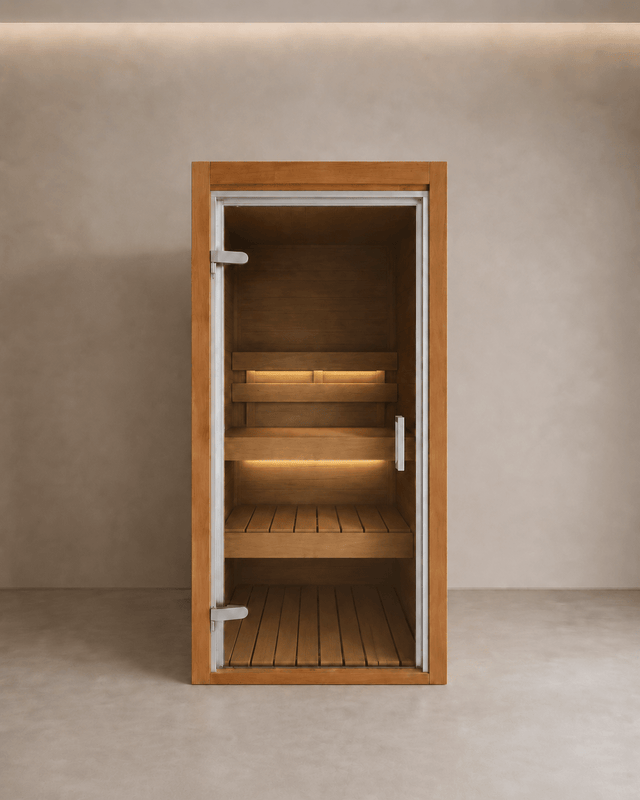
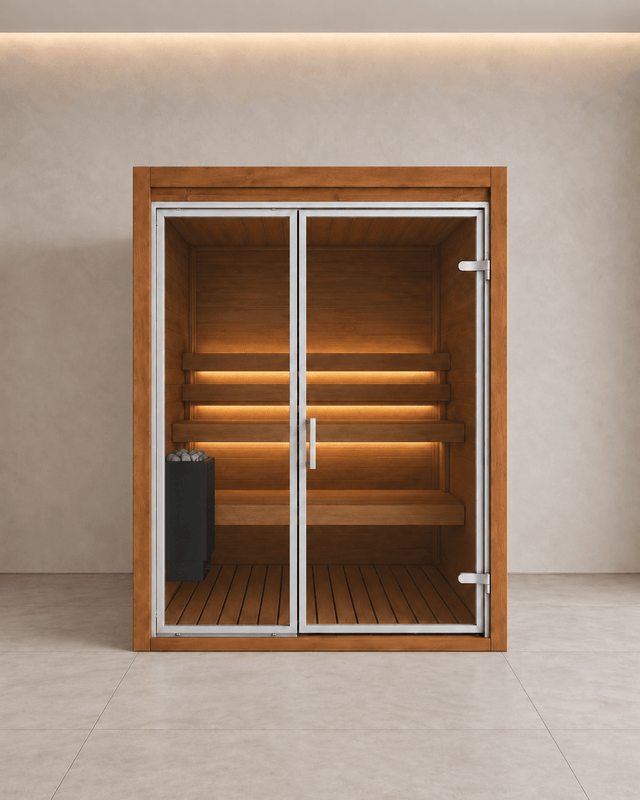
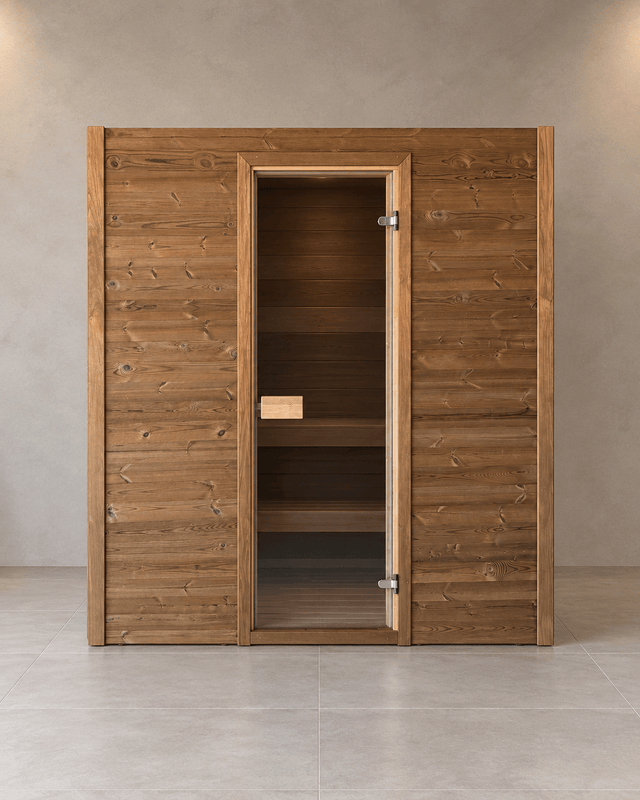
For a sauna cabin rather than a fully built-in room, coordination can be simpler, but it still begins with the available space. Check ceiling height, door movement, assembly clearances and the delivery route alongside the cabin footprint. Saunamo’s current indoor sauna collection provides model dimensions; the 3D sauna designer can help explore how a layout sits within the room.

What ownership feels like after the novelty wears off
A timber sauna needs to dry properly after use. Follow the manufacturer’s ventilation and drying instructions, remove wet towels and containers, and let moisture from bathing and löyly dissipate. Cleaning is easier when it is part of the routine rather than left until marks have built up.
The work is generally visible and intuitive: air the room, wipe or clean the benches as required, keep the floor clean and periodically inspect the heater and stones according to the heater manufacturer’s instructions. If you use water on the stones — as a Finnish sauna is intended to allow — the room still needs good drying, but you are not maintaining a boiler that produces steam continuously.
A steam room has more surfaces that become wet at every use and more mechanical components in contact with water. Condensation runs down walls and glass; joints and drainage need to remain clean; and the steam generator gradually accumulates mineral deposits from its water supply.
Water hardness is local rather than national. Lisbon’s EPAL, for example, publishes a range of hardness values across its supply area. A buyer in Portugal or Spain should check the supply at the property and ask what the selected generator requires. That is more useful than assuming that all water in either country needs the same treatment.
Harvia explicitly warns that calcium, magnesium and other mineral deposits can shorten steam-generator life and recommends appropriate filtration or water softening where necessary. Its steam-generator documentation also treats decalcification as equipment-specific maintenance. There is no responsible universal schedule such as “descale every three months”: the interval depends on the generator, use and water quality, so the owner should follow the exact manual supplied with the installed model.
For a holiday home or a property occupied intermittently, that distinction can be important. A sauna that is well dried and ventilated after use has relatively straightforward dormant periods. A steam system adds water-fed equipment, drains and maintenance that should remain accessible even if the room itself looks seamless.

Sauna and steam room at a glance
| Question | Finnish sauna | Steam room / hammam |
|---|---|---|
| Typical air temperature | Often around 70–100°C, depending on the sauna and the bather’s preference | Around 40–50°C, according to the chosen steam-room system |
| How does it feel? | Hotter air, with intensity changed by adding water to heated stones | Lower air temperature but continuously very humid, with persistent vapor and condensation |
| Where does the moisture come from? | Mainly from bathers and transient löyly | A dedicated steam generator continuously supplies steam |
| Typical interior character | Timber-lined, warm and tactile | Tile, stone, glass or other waterproof finishes |
| Key construction issue | Heat retention, vapor control, ventilation and heater safety | Full wet-area waterproofing, drainage and condensation management |
| Main equipment | Sauna heater or stove with stones | Steam generator, steam pipe and outlet |
| Service planning | Heater, controls, sensors and electrical connection must remain correctly installed and serviceable | Generator, valves, drain and steam line need deliberate service access |
| Routine ownership | Dry the room, clean benches and floor, inspect heater/stones as required | Clean wet surfaces and drainage; monitor and descale generator according to water quality and model |
| Best suited to | People who enjoy strong heat, timber and adjustable löyly | People who prefer enveloping humidity at a lower air temperature |
These are typical characteristics, not installation specifications. The exact operating limits, ventilation and service requirements come from the manuals for the chosen heater or generator.
Three home situations where the choice becomes clearer
A compact renovation. In a small bathroom, gym or spare room, a prefabricated or custom sauna cabin can sometimes be easier to coordinate than a new saturated wet room. Saunamo’s indoor range includes compact one- and two-person formats. A sensible fit still depends on door swing, assembly clearance and access, as well as the floor area.
If the space is already being rebuilt as a properly tanked shower or wet room, however, steam can become more logical because waterproofing, drainage and plumbing are already central to the project. The right choice depends less on the nominal room size than on what construction work is already planned.
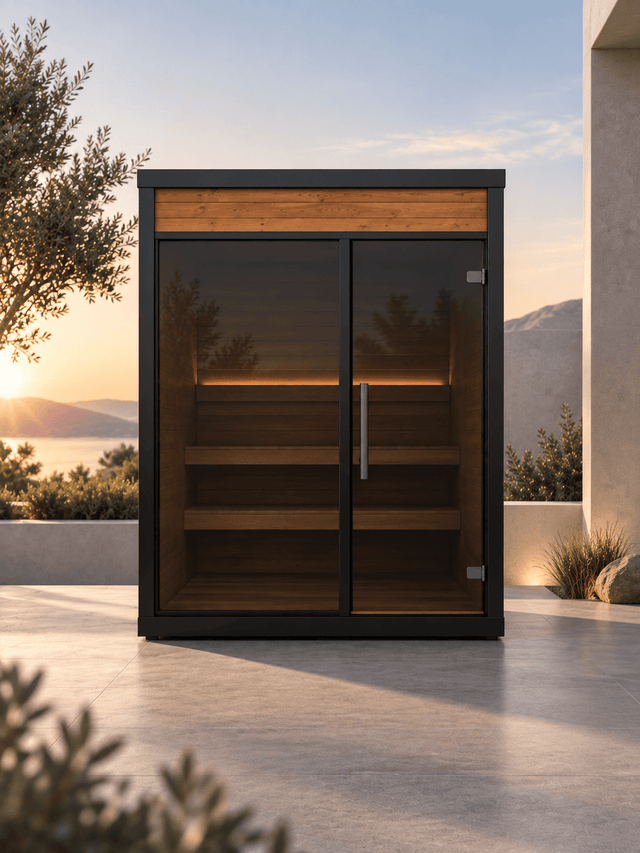
A garden installation. A standalone garden sauna brings the insulated enclosure, heater, benches and ventilation together in one structure. The main questions become the foundation, heating system, weather protection and the route between the sauna and the house.
A garden steam room is certainly possible, but it introduces water supply, drainage, freeze protection where relevant and a service location for the generator. For many homeowners seeking a self-contained garden retreat rather than an extension of a bathroom, those extra systems can make sauna the simpler architectural proposition.
A property used by several people. Capacity is more than the number printed on a product page. In a sauna, bench length, bench levels, heater position and circulation determine how comfortably people can sit together. Saunamo’s 3D sauna designer lets buyers explore those proportions before technical review. A layout drawing is especially useful when several people expect to use the room at the same time.
In a frequently shared steam room, the balance shifts toward robust waterproof finishes, drainage, easy cleaning and a generator sized for the enclosure and usage pattern. Harvia specifically differentiates some material and ventilation requirements between domestic and public or heavier-use steam rooms, which is a useful reminder that “home” equipment should be selected around real occupancy rather than occasional solo use.
Which one should you choose?
If your ideal ritual is unmistakably hot — timber underfoot, a heater full of stones, the room settling into temperature and then changing as you add a ladle of water — choose a Finnish sauna. The humidity is part of the experience, but it comes in waves, under your control.
If your preference is for softer air temperature, dense humidity and a room that remains wet and vapor-filled throughout the session, choose a steam room. Accept that you are also choosing a more intensive wet-area construction and a water-fed generator that will need servicing over its life.
For an existing home, the architecture often breaks the tie. A well-planned sauna cabin can fit into surprisingly modest spaces, provided the electrical supply, ventilation, heater clearances and installation route are right. A steam room asks more of the building envelope but integrates elegantly into a renovation already designed as a fully waterproof wet area.
A well-chosen room earns its place through repeated use. The strongest choice is the heat you look forward to, supported by construction and upkeep that make sense for the home you own.
To turn your choice into a project budget, see our guide to home sauna costs, with cabin prices and the work to specify separately.
Related post

What does a home sauna really cost?
Sauna or steam room: which suits your home?

Como montar sauna e banho de gelo em casa (layout e rotina)

Sauna exterior pequena: como verificar se cabe no seu espaço


